TRAINING (2.5.1)

SwissCollNet si impegna a migliorare l'accessibilità delle collezioni di storia naturale. Una visione comune e una strategia a lungo termine promuoveranno l'uso delle collezioni di storia naturale per la ricerca, l'insegnamento e la società.

Immagine: OscarLoRo, stock.adobe.com

In search of giants: Santiago Roth’s Fossil Legacy

After leaving the Swiss Alps for the vast plains of Argentina in the mid-19th century, Santiago Roth found his true calling beneath the soil, unearthing fossils of South American’s prehistoric megafauna. His remarkable discoveries – like the mysterious ‘nose-boned’ Neosclerocalyptus – now help scientists at the University of Zurich investigate the evolution of these ancient mammals.
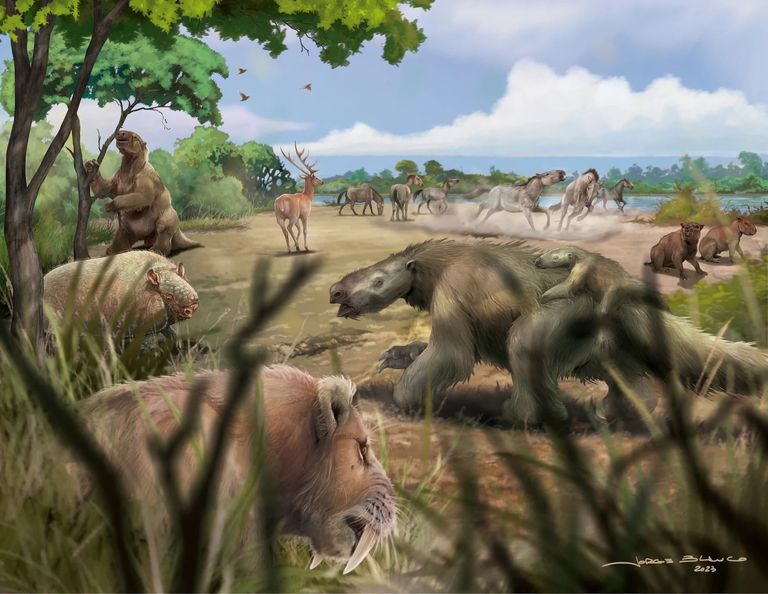
A reconstruction of the landscape in the Pampean region during the Early Pleistocene (about 1 million years ago). The animal on the left in the middle is Neosclerocalyptus.
A reconstruction of the landscape in the Pampean region during the Early Pleistocene (about 1 million years ago). The animal on the left in the middle is Neosclerocalyptus.Immagine: Voglino D., Carrillo-Briceño J.D., Furrer H. et al. (2023) Swiss J Palaeontol 142, 25
Immagine: Voglino D., Carrillo-Briceño J.D., Furrer H. et al. (2023) Swiss J Palaeontol 142, 25

His story is as curious as the fossils he found. Kaspar Jakob Roth (1850–1924) was brought to Buenos Aires from Herisau, in Appenzell, at the age of 16 years old, when his family emigrated. They were saddlers, much-needed business in the land of the gauchos. Santiago (his adopted name in Argentina) was meant to keep the business going, but he had another plan: he was astonished by natural history and spent his spare time on expeditions, collecting plants, butterflies and fossils. Fascination turned into vocation: he started out selling his spectacular finds, moved on to research, and, despite lacking formal credentials, became a professor. Some of Santiago’s fossils ended up in museums in Europe, including the now Natural History Museum of the University of Zurich, which showcases the gigantic Megatherium and Glyptodon in the permanent exhibition.

The bony nose of a giant

Glyptodonts are an extinct group of armadillos, some of them were huge (reaching about four metres in length and two tons in weight). From head to tail, their body was covered with bony plates called osteoderms. Even among these extraordinary beasts, one defied expectation: Neosclerocalyptus, a creature that had evolved a distinctive bony swelling in front of its nose. This ‘new bone’, which probably originates from the nasal cartilage, is a phenomenon completely unknown in the world of mammals. It is seen in many animals of this genus (therefore cannot be a disease frozen in time) and some differences in the shape of this ‘nose bone’ are used to differentiate between the five recognized species. The only species that has been studied in detail before is Neosclerocalyptus paskoensis, which is geologically the youngest.

Now thanks to the support of SwissCollNet, the Department of Paleontology of the University of Zurich has been able to 3D scan a large amount of specimens from the Roth collection (available here). These findings will help researchers understand the evolution and possible functions of the ‘nose bone’ in these fascinating animals. A study on this topic has just been published in the Journal of Vertebrate Paleontology (available here).

SwissCollNet

The Swiss Natural History Collections Network (SwissCollNet) is an initiative from the Swiss Academy of Sciences, dedicated to the digitization and long-term management of Swiss natural science collections. SwissCollNet has supported 68 projects conducted in Switzerland’s museums, universities, and botanical gardens, covering extensive collections of animals, plants, fungi, rocks, fossils, and DNA samples.
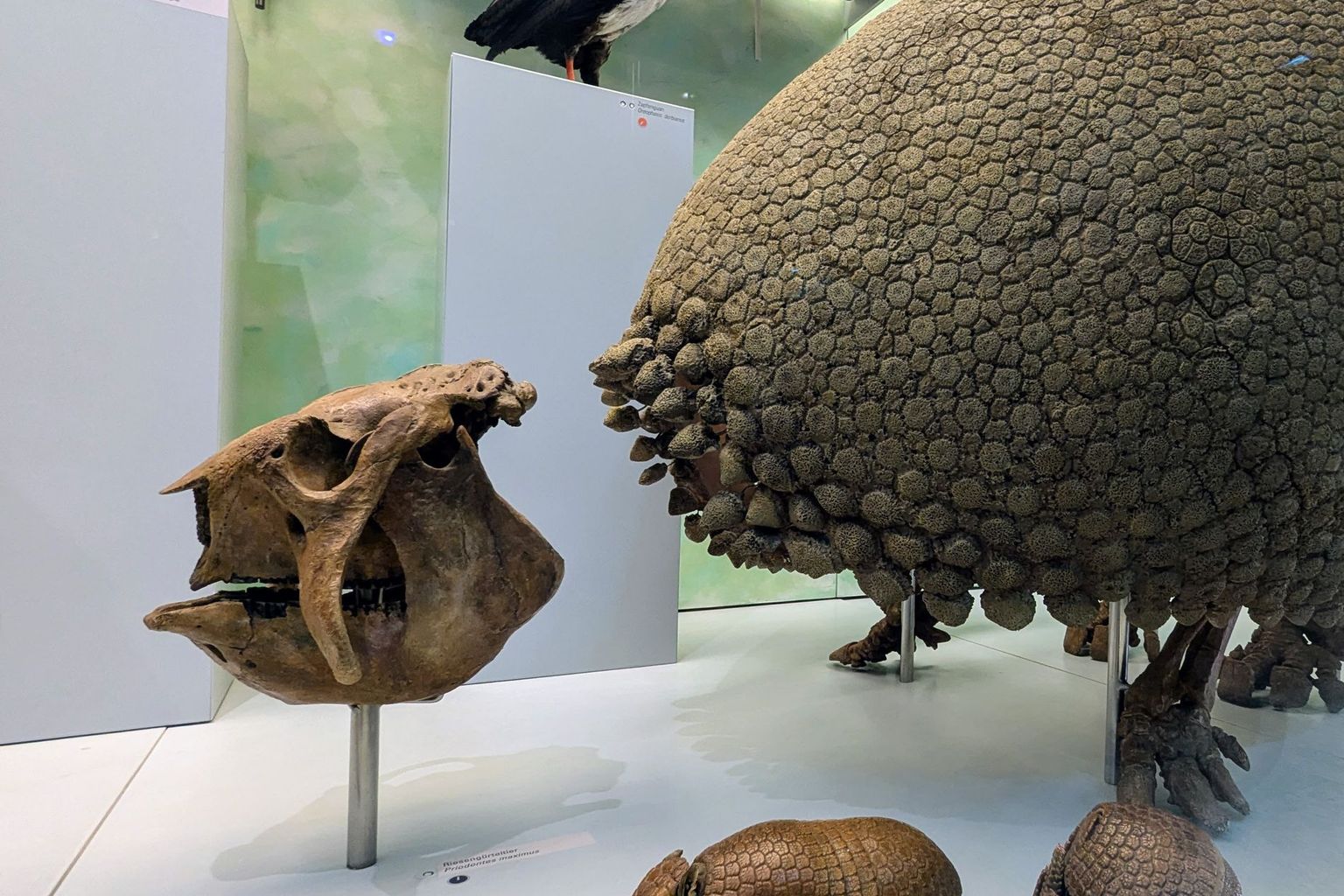
  • A glyptodon found by Roth which is displayed in the permanent exhibitions of the Natural History Museum of the University of Zurich beside one of its extant relatives, the three-banded armadillo Tolypeutes.
  • Santiago Roth pointing to the armour of a glyptodon in the vicinity of Pergamino, taken ca.1890.
  • A reconstruction of the landscape in the Pampean region during the Early Pleistocene (about 1 million years ago). The animal on the left in the middle is Neosclerocalyptus.
  • The skull of Neosclerocalyptus pseudornatus currently under study. Researchers at the UZH scanned to find out the function and evolution of the unique nasal cartilage ossification. Scale: 10 cm
  • A glyptodon found by Roth which is displayed in the permanent exhibitions of the Natural History Museum of the University of Zurich beside one of its extant relatives, the three-banded armadillo Tolypeutes.Immagine: Gabriel Aguirre/NMZ1/4
  • Santiago Roth pointing to the armour of a glyptodon in the vicinity of Pergamino, taken ca.1890.Immagine: Photo from: Weigelt, G. (1951) Berner Zeitschrift Für Geschichte Und Heimatkunde, 1, 19–39.2/4
  • A reconstruction of the landscape in the Pampean region during the Early Pleistocene (about 1 million years ago). The animal on the left in the middle is Neosclerocalyptus.Immagine: Illustration from:Voglino D., Carrillo-Briceño J.D., Furrer H. et al. (2023) Swiss J Palaeontol 142, 253/4
  • The skull of Neosclerocalyptus pseudornatus currently under study. Researchers at the UZH scanned to find out the function and evolution of the unique nasal cartilage ossification. Scale: 10 cmImmagine: Modified from: Le Verger, K. (2023) Swiss J Palaeontol 142, 3.4/4
  • A glyptodon found by Roth which is displayed in the permanent exhibitions of the Natural History Museum of the University of Zurich beside one of its extant relatives, the three-banded armadillo Tolypeutes.
  • Santiago Roth pointing to the armour of a glyptodon in the vicinity of Pergamino, taken ca.1890.
  • A reconstruction of the landscape in the Pampean region during the Early Pleistocene (about 1 million years ago). The animal on the left in the middle is Neosclerocalyptus.
  • The skull of Neosclerocalyptus pseudornatus currently under study. Researchers at the UZH scanned to find out the function and evolution of the unique nasal cartilage ossification. Scale: 10 cm
A glyptodon found by Roth which is displayed in the permanent exhibitions of the Natural History Museum of the University of Zurich beside one of its extant relatives, the three-banded armadillo Tolypeutes.Immagine: Gabriel Aguirre/NMZ1/4

Categorie

  • Paleontologia (biol.)

Contatto

Dr. Gabriel Aguirre
UZH
Paläontologisches Institut der Universität Zürich
Karl Schmid-Strasse 4
8006 Zurigo